

Welcome to SolMem
We provide solar-driven, innovative, and low cost engineering solutions to water and wastewater challenges
About SolMem
Our Story
SolMem Team
Water and energy scarcity are among the defining challenges of our time. Water treatment stands as one of the great engineering achievements of the 20th century, underpinning modern economic growth — yet that legacy is now strained by a global water crisis threatening public health and economic development worldwide. Next-generation water and wastewater treatment systems must keep pace with growing scarcity and contamination driven by continued industrialization.
We are a team of engineers and innovators who believe that novel technology and rigorous engineering are essential to solving this challenge.
Conceived in an engineering lab at Rice University in Houston, Texas, SolMem transforms cutting-edge research into practical technology — treating water with less chemical input and less energy. Our R&D team develops low-cost, high-efficiency treatment systems powered by renewable energy, engineered to solve the toughest water and wastewater challenges facing industry today. Our solar-powered membrane distillation technology brings reliable water treatment to off-grid and resource-constrained locations where conventional infrastructure falls short.
Whether you're facing a water treatment challenge, have an idea worth exploring, or are looking for a partner, we'd like to hear from you.
Qilin Li, Ph.D.
Professor of Environmental Engineering
Founder and President of SolMem
.jpeg)
Awards

1st place
2016 American Water Summit Techno Idol Competition
(Miami, FL, USA)

2nd place
2017 Black Horse Environmental Protection Innovation and Entrepreneurship Competition
(Beijing, China)


1st place
2016 American Water Summit Techno Idol Competition
(Miami, FL, USA)


What is SolarMEMD Technology?
SolarMEMD Technology
Solar Multi-Effect Membrane Distillation (SolarMEMD) is a patented technology that directly harnesses sunlight to desalinate and purify saline waste streams — including oil & gas produced water, agricultural wastewater, brackish water, RO concentrate, and seawater. Unlike conventional desalination methods that require high temperature or high pressure, SolarMEMD operates under ambient conditions and is powered entirely by solar energy. This allows communities and industries to treat a wide range of unconventional source waters — from seawater and brackish water to industrial wastewater — to drinking water quality, at low cost.
SolarMEMD is patented in the United States and China.
Basic Principle
A SolarMEMD system uses sunlight directly to drive a novel membrane distillation process that vaporizes and recovers pure water from a wide range of waste streams. The process relies on a nanotechnology-enabled photothermal membrane that harvests solar energy while simultaneously desalinating saline water. A nanocomposite coating absorbs sunlight and converts it to heat with high efficiency at the membrane surface, evaporating the saline water stream. The hydrophobic membrane retains all salts and other contaminants while allowing water vapor to pass through its porous structure; pure water is then generated as the vapor condenses. This eliminates the substantial electrical energy consumption required by most conventional desalination technologies.
Our customers need a low-cost, efficient solution for alternative and additional freshwater supply — particularly in arid and semi-arid regions, as well as for off-grid communities globally.

Features of SolarMEMD
100% Solar Powered
Energy Efficient
High Water Recovery
Simple Modular Design
Our system is completely powered by solar energy with the option to use electricity when access to a power grid is available. Unlike other solar powered water treatment systems, only a very small fraction of our system energy need is provided by solar photovoltaic panels. The SolarMEMD process itself utilizes sun light directly. This allows our system to operate off-grid, a very important feature for communities and industry operations at locations without reliable access to the power grid.
The SolarMEMD process provides heating on the membrane surface instead of to the saline feed water. It overcomes inherent limitations of the conventional membrane distillation process, providing > 75% single stage energy efficiency (i.e., percent of energy in the incident sunlight utilized to evaporate water). In addition, our novel multistage membrane module design and system level energy management strategies provide high energy recovery to drastically reduce net energy consumption.
Water recovery is extremely important in areas where water resources are scarce. Surface heating and the inherent high scaling resistance of the SolarMEMD process allows water recovery several times higher in our system than in conventional membrane distillation. This not only maximizes water supply, but also minimizes costs for brine disposal.
Our system uses a simple modular design that can accommodate a wide range of production rate. System expansion and modification can be easily achieved without major system reconfiguration. We also offer mobile features for customers with changing operation locations.
Applications
SolarMEMD Applications
Brackish Water and Seawater

Brackish water and seawater are two highly abundant saline water sources that can become an important water supply in areas with limited freshwater resources.
Brackish water typically ranges from 1,000 to10,000 ppm in total dissolved solids (TDS) concentration, while seawater has a typical TDS of 30,000 – 40,000 ppm.
SolarMEMD can efficiently desalinate these water sources with water recovery (freshwater produced over feedwater intake) of 85 – 90 % for brackish water, and up to 75% for seawater.

RO Concentrate Management
Brine discharge from reverse osmosis (RO) desalination plants has a TDS content up to 75,000 ppm. The water recovery of a reverse osmosis desalination plant (up to 50% for seawater desalination, and up to 75% for brackish water desalination) can be improved by further processing the waste brine, but the high TDS content of the waste brine makes it difficult to treat further with RO. SolarMEMD can effectively treat waste brine to improve water recovery in existing RO desalination plants.

Zero Liquid Discharge (ZLD)
Zero liquid discharge (ZLD) is one such management strategy being investigated, in which ~100% of liquid waste is recycled for beneficial reuse. In the scope of ZLD for managing produced water, beneficial reuse options include applications that are both internal (e.g., re-injection for oil recovery) and external (e.g., irrigation for livestock and agriculture, mineral recovery etc.). The high thermal efficiency, low energy consumption, scalability, and potential for modulation makes SolarMEMD, a cost-effective, off-grid, desalination technology that can prove critical in the “Water-Energy Nexus”.


High Salinity Industrial Wastewater Treatment
SolarMEMD technology offers a low cost, energy efficient solution to treatment of waste streams that contain high salt concentration, including concentrated brines from various industrial processes.
Brine discharge from reverse osmosis (RO) desalination plants has a TDS content up to 75,000 ppm. Treatment of RO concentrate using the SolarMEMD technology can not only improve the overall water recovery of a reverse osmosis desalination plant (up to 50% for seawater and up to 75% for brackish water without water recovery from the brine), but also minimize the cost for brine disposal.
Wastewater from the sugar and steel industries can have a TDS concentration of 100,000 ppm and above. These are extremely challenging wastewaters with few treatment options due to the high TDS and other harmful chemical contaminants in them. Our system can treat industrial wastewaters with a TDS content of up to 200,000 ppm.
Oil Produced Water

Produced water is wastewater coproduced during the extraction of fossil fuels from geologic formations. Currently, the output of produced water exceeds oil production at a volumetric ratio of 3:1 globally and 10:1 in the US. As of August 2019, the daily production of fossil fuels, globally, was estimated at 101 Billion barrels. In addition to large volumes, produced water is infamous for containing high concentrations of dissolved ions and suspended solids, as well as residual amounts of hydrocarbons and toxic frac fluid additives.
Solar MEMD technology offer cost-effective solution to the produced water using only the solar energy.
Water Scarcity Map
Technology Adoption Revolution

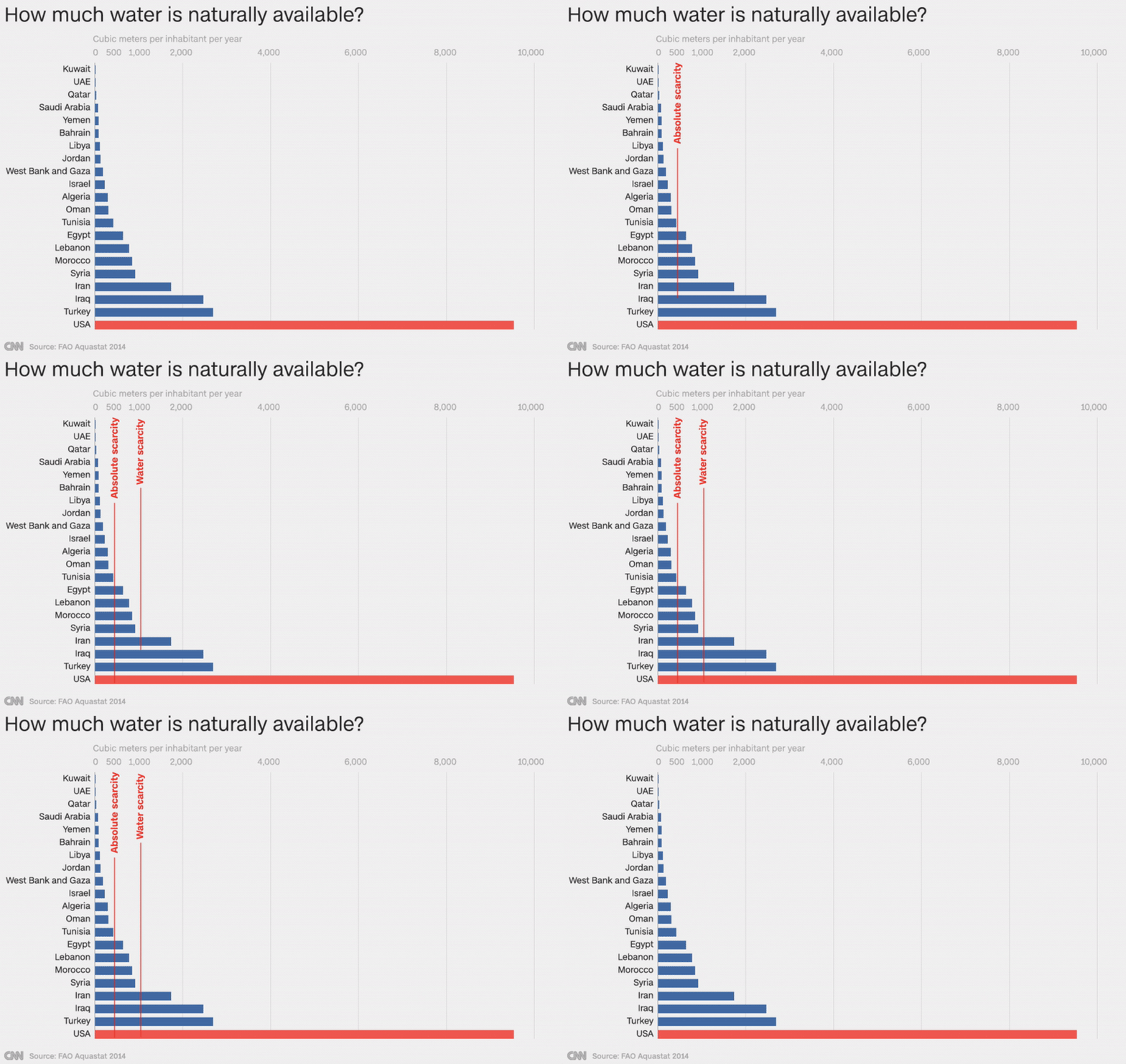
*Images via CNN News